
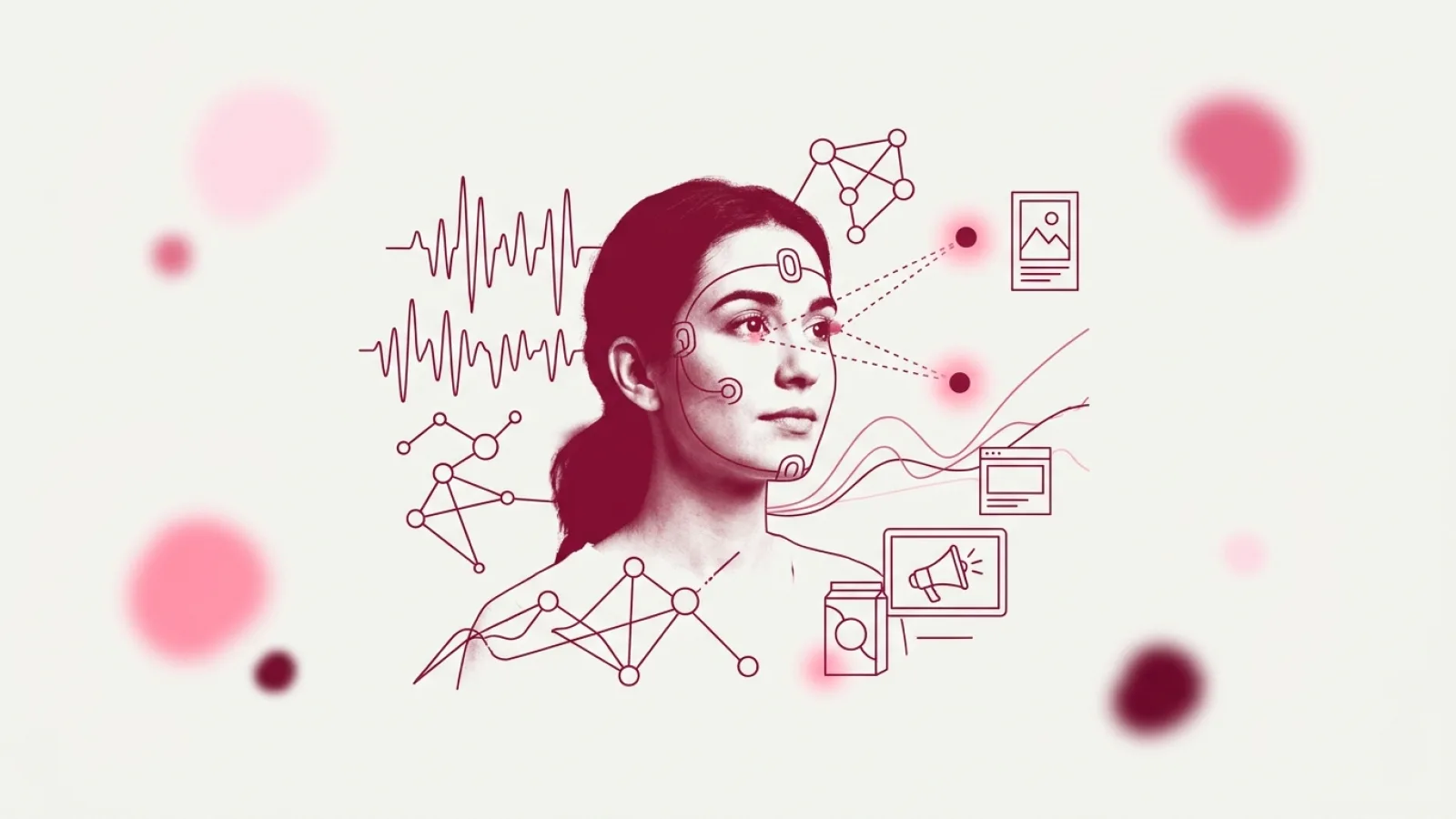
Automated facial expression analysis, usually called facial coding, uses a camera to record facial movements while a person watches an ad and turns them into frame-by-frame coded data. It is one of the most accessible techniques in neuromarketing: a webcam is enough, there is no physical contact with the participant, and data collection scales to hundreds of people. That accessibility calls for careful reading, because the gap between detecting a facial movement and claiming an emotion is wider than many results dashboards suggest. This article covers the method, its documented accuracy, and the practices that make it rigorous.
Why is FACS still the foundation of facial coding?
The Facial Action Coding System (FACS), published by Paul Ekman and Wallace Friesen in 1978, describes the face in anatomical terms. Each visible movement is coded as an action unit (AU) tied to one or more muscles. Its key strength is that it separates description from interpretation: the coder records that the corrugator muscle contracted and leaves the question of meaning for a later stage.
Some units that come up often in advertising research:
- AU4, brow lowerer. Contraction of the corrugator between the eyebrows. It appears in displeasure, and also in effortful comprehension or concentration.
- AU12, lip corner puller. Action of the zygomaticus major; the core component of a smile.
- AU6, cheek raiser. Action of the orbicularis oculi, which creates creases at the outer corners of the eyes. The AU6+AU12 combination is the so-called Duchenne smile, which the literature links more often to spontaneous enjoyment.
- AU9 and AU15, nose wrinkler and lip corner depressor. Part of the prototypical configurations for disgust and sadness.
Manual coding requires certified coders and frame-by-frame work that does not scale to large samples. Automation made it feasible to apply FACS to studies with dozens or hundreds of participants.
How does software detect action units?
Current systems share a four-stage sequence.
1. Face and landmarks
The algorithm finds the face in each frame and places landmarks on the eyebrows, eyes, nose, lips and jawline. From these it estimates head orientation and normalizes the image so frames can be compared.
2. Image features
Classic approaches combine landmark geometry with texture descriptors that capture wrinkles and folds. Deep learning models learn those features directly from pixels.
3. Detecting each AU
A classifier estimates the presence or intensity of each unit, frame by frame. It is trained on video databases coded by FACS experts, and its performance depends on how closely those databases resemble the conditions of the study.
4. The inference layer
Many systems add a final step: they combine AUs into emotion categories (joy, surprise, disgust) or into valence and arousal indices. This layer is where the method is most fragile.
Among open-source tools, OpenFace 2.0 (Baltrušaitis et al., 2018) estimates facial landmarks, head pose, gaze direction and AUs, and Py-Feat (Cheong et al., 2023, Affective Science) brings detection, preprocessing, analysis and visualization of facial data together in Python. Commercial solutions offer production-ready workflows and support, built on closed models. The choice comes down to how much weight a team gives model transparency and reproducibility versus operational convenience.
How accurate is automated coding?
It depends mainly on the type of expression. Models perform best on posed, intense, prototypical expressions and lose accuracy on spontaneous ones, which are exactly the kind people show while watching an ad.
Dupré, Krumhuber, Küster and McKeown (2020) compared eight commercial classifiers with human observers on 937 videos of posed and spontaneous expressions. Humans outperformed the automated systems, whose accuracy ranged from 48% to 62%. The two best classifiers came close to human performance on posed expressions, and all of them were less accurate on spontaneous behavior. PLOS ONE, 2020.
Two further findings complete the picture. Höfling and colleagues (2022) asked 70 untrained participants to express six emotions and compared the results with photographs of trained actors: AU intensities were lower for every emotion, and some emotions were misclassified more often (PLOS ONE, 2022). Krumhuber and colleagues (2021) validated 14 databases of dynamic expressions and found that classification accuracy tracks how prototypical an expression is, and that it shifts with technical factors such as head rotation, face size in the frame and motion (Behavior Research Methods).
Can emotion be read from a face?
This is the heart of the debate. The review by Barrett, Adolphs, Marsella, Martinez and Pollak (2019) concludes that people do smile when happy or scowl when angry more often than chance would predict, but that the way each emotion is expressed varies substantially across cultures, situations and even across people in the same situation. A single facial configuration can express more than one emotion, and a scowl often communicates something other than an emotional state (Psychological Science in the Public Interest, 2019).
A study with professional actors reinforces the point: when portraying 13 emotion categories in context-rich scenarios, only fear, happiness and surprise were expressed with moderate reliability and specificity (Le Mau et al., 2021, Nature Communications).
The practical consequence is straightforward. The AU and its timing are the data; the emotion is a hypothesis that needs context. "AU4 at second 12" is a measurement. "Confusion at second 12" is an interpretation that should be checked against another source, such as a comprehension question or gaze data.
Why do faces barely move during ads?
Watching advertising alone in front of a screen produces few expressions. McDuff, el Kaliouby, Cohn and Picard (2015) analyzed more than 12,000 facial responses from 1,223 people to 170 ads, recorded via webcam. Detected expressions were sparse, yet the aggregate response revealed rich emotional trajectories and predicted ad liking (ROC AUC = 0.85) and, less accurately, change in purchase intent (ROC AUC = 0.78). Peak positive responses immediately preceded by a brand appearance were associated with greater effectiveness (IEEE Transactions on Affective Computing).
Two rules follow. The unit of analysis is the aggregate curve across the sample, and sample size has to be planned around that sparsity. And a neutral face is fully compatible with sustained attention and physiological arousal; capturing those requires other signals.
Which practices make a facial coding study reliable?
- A per-participant baseline. A neutral period before the stimuli lets you analyze each person's change relative to themselves and control for individual differences in the resting face.
- Controlled lighting and framing. Even, frontal light, the camera at eye level, no backlighting and no shadow across half the face. The technical factors Krumhuber identified affect accuracy as much as the expression itself.
- AU-level hypotheses. Before fieldwork, the team specifies which units it expects and when: AU12 at the brand reveal, AU4 on the text-heavy scene.
- Combining measures. In the study by Höfling and colleagues (2020), skin conductance was specifically associated with self-reported arousal, while the facial arousal index correlated more with valence (Frontiers in Psychology). That is why it pays to add GSR for intensity, eye tracking to know where people were looking, and self-report for interpretation.
- Explicit consent. Face video is biometric data; informed consent should describe how it is recorded, used and stored.
In Neurolab lab studies, facial coding is synchronized with GSR, EEG and eye tracking, so each AU is read alongside the gaze and arousal recorded at the same moment.
If your team is planning to add facial coding to an ad pretest or a lab study, book a meeting with our team to define the right design, metrics and sample.
