
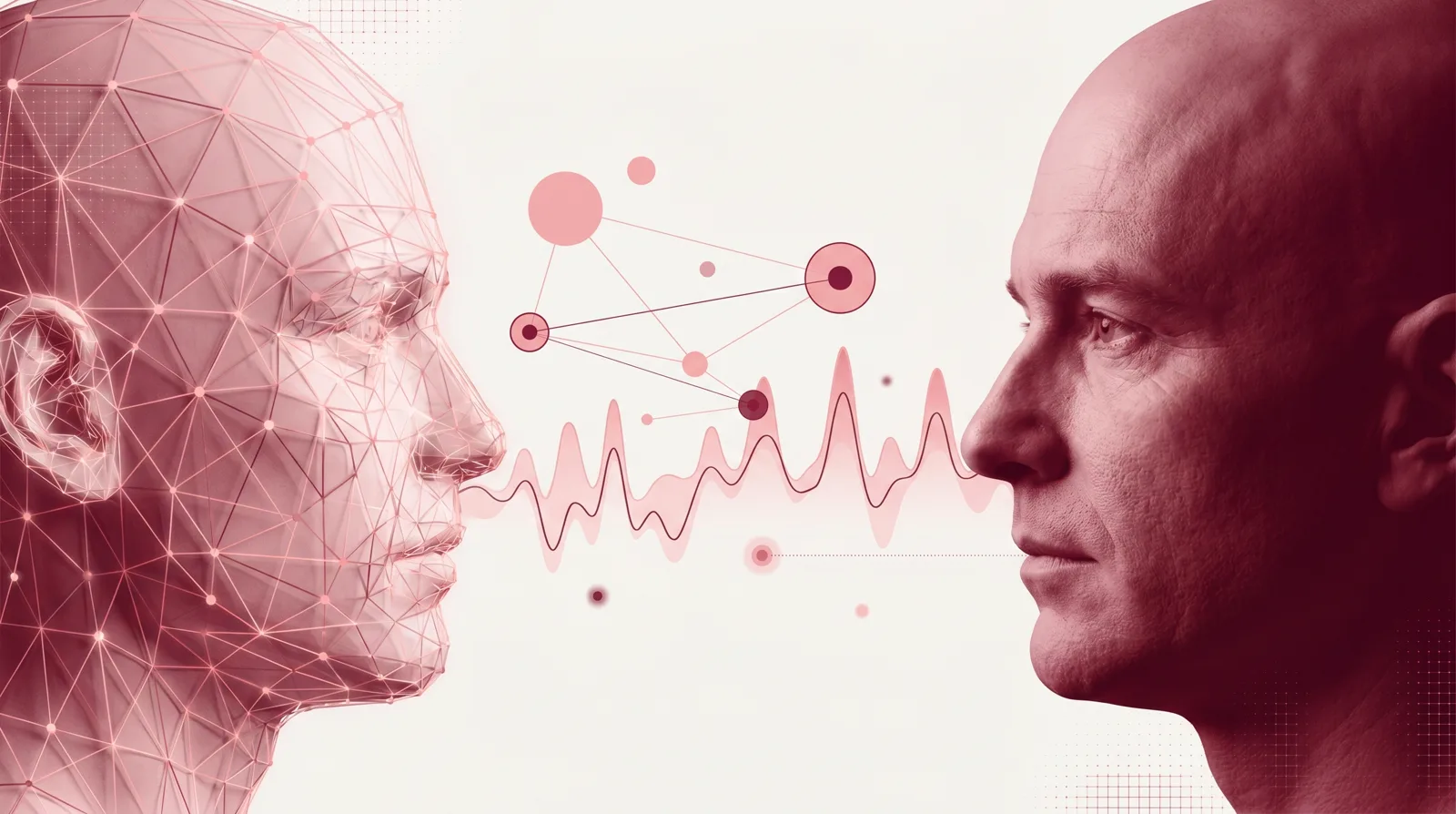
Consumer digital twins promise speed and scale for market research. But their validity is still uneven, for a reason marketing has known for decades: what people say and how they actually respond are two different things.
The market research industry is enormously excited about synthetic methods: AI-generated personas that simulate how consumers think and respond. The promise is seductive — testing concepts, prices and messaging at scale, in hours rather than weeks. The serious question is a different one: can you trust what these models predict? And if not entirely, how do you validate it?
What is a consumer digital twin?
The terminology is not settled yet, and it is worth sorting out. The market is converging on three categories of synthetic method, distinguished mainly by how firmly anchored they are in data from real people:
- Pure synthetic respondents. AI-generated personas built from census data, behavioral modeling and large language models (LLMs). They are not tied to any real individual. They serve population-level simulation and exploratory work.
- Synthetic consumers. A specialization of the above, tuned for market research: they replicate how shoppers think and act when evaluating concepts, prices and messaging. They are used for concept testing and early exploration.
- Consumer digital twins. The most anchored end of the spectrum. A twin is the virtual representation of a specific person (or a well-defined micro-segment), built from real individual data — surveys, behavioral observation, transaction history, interviews — and designed to evolve over time.
The distinction matters because the validation strategy changes with each category: a synthetic respondent is validated against aggregate population statistics; a twin, against the real responses of the person or segment it represents.
How they are built, in practice
Most implementations combine three layers of data:
- Behavioral and transactional data. The empirical skeleton: purchase history, web and app interactions, loyalty programs, CRM. Their advantage is being observed rather than reported, and they supply the temporal patterns that make a twin dynamic.
- Stated preferences and attitudinal data. What the person says about themselves: surveys, interview transcripts, focus groups. They bring motivations that behavioral data does not capture.
- Demographic and contextual data. They anchor the twin in a defined population — age, income, geography, life stage. Research shows LLM-based synthetics perform considerably better when instructed to consider demographic attributes, with age and income especially decisive.
A twin is usually implemented as an LLM with structured access to that data, reinforced with retrieval (RAG) over the individual’s transcripts and records, and constrained by prompting or fine-tuning to answer "in character". The most sophisticated versions add purchase intent, attention and emotion models.
Where they are being applied
Marketing applications cluster around five overlapping uses:
- Concept and product testing. The highest-volume use: exposing a twin (or a population of target twins) to a concept, package or formulation and collecting predicted responses on liking, uniqueness, purchase intent and category fit.
- Customer journey simulation. Segment twins exposed to onboarding, retention or service variants, to anticipate which path performs best.
- Pricing and assortment. Conjoint-style studies and willingness to pay at a far greater scale than traditional human studies.
- Personalization and segmentation. Testing recommendations, content variants or offers before taking them to a live A/B test.
The validity problem
Methodological enthusiasm coexists with a validity literature that, as of late 2025 and early 2026, is clearly uneven.
The encouraging findings are real: peer-reviewed work has shown that LLM-based synthetic respondents reproduce certain aggregate patterns in opinion, consumption preference and qualitative response. Universities such as Harvard Business School and MIT Sloan are studying these methods seriously.
The discouraging findings are real too. And recurring failure modes show up:
- Sycophancy and positive bias. LLMs, trained to be agreeable, tend to give unrealistically positive feedback and to miss the flaws a real consumer would point out.
- Insufficient variance. Synthetic distributions tend to be too smooth and too centered, erasing the outliers that characterize real behavior.
- Social desirability. The models exhibit social desirability biases — exactly what good research sets out to get around.
- Prompt sensitivity. Estimates vary considerably with prompt wording and option order.
- Population validity, not individual validity. They can replicate aggregate patterns reasonably well but fail at predicting specific individuals — critical for personalization.
- Hallucinations. They sometimes fabricate plausible but false information.
The honest summary: digital twins are useful, but not yet trustworthy on their own. They generate hypotheses, replicate certain aggregate patterns and produce informative qualitative output, but their outputs need calibrating against real human response before consequential decisions.
Why biosensor validation is decisive
Here the story takes its most interesting turn for marketing. Traditional validation uses human surveys as ground truth: comparing the twin’s prediction with what real people reported on the same items. That is necessary but insufficient, for something marketing has known for decades: what a consumer says and how they respond are not the same thing.
The mere act of reflecting on an answer can change it, and self-report is subject to social desirability, recall bias and post-rationalization. A twin trained to predict what people say will, at best, predict what people say. It does not necessarily predict pre-conscious attention, emotional valence or cognitive load — the dimensions that explain most of the decision.

Biosensor-based validation closes that gap. The procedure is simple in principle: run the same stimulus the twin evaluated through a small but representative sample of real people, instrumented with eye tracking, facial coding, GSR and, where appropriate, EEG. Then the twin’s predictions — visual attention, emotional response, arousal, cognitive load — are compared with the recorded physiological responses, and the discrepancies are used to calibrate the model.
This calibration loop has attractive properties: biometric measures are less susceptible to the biases affecting both surveys and synthetics; they produce continuous, time-resolved data rather than a single score; and they are hard to inadvertently leak into model training.
Databrain Lab supplies the ground truth
Validating a twin requires a multimodal biosensor platform. Databrain Lab integrates eye tracking, facial coding, GSR/EDA, EEG and ECG in a synchronized capture and analysis environment, with capabilities directly relevant to this task:
- Multimodal stimulus testing. The same study design applied on screen, in the field (with eye-tracking glasses) and in natural contexts — packaging, retail, digital advertising — reducing methodological variance across contexts.
- Coverage of neuromarketing methodologies. Visual attention through eye tracking, emotional response through facial coding, physiological arousal through GSR and neural response through EEG. Each maps a dimension the twin is trying to predict.
- Survey integration. Triangulating, in a single study, what the participant states (what the twin was trained to predict) with their non-conscious biometric response (the independent validation).
- Scalability. From remote webcam studies for large samples and fast iteration, to high-fidelity lab setups for fine-grained validation.
- Export and integration. Raw data and derived metrics in formats compatible with R, Python and SPSS, to feed the same pipeline that trains and evaluates the twin.
A representative validation flow
- The team builds or licenses a twin of the target segment, anchored in available individual data. Stimulus variants are generated (creatives, packaging, concepts, flows).
- The twin evaluates each variant and produces predicted scores (liking, attention, emotional valence, purchase intent) plus qualitative explanations. Variants are ranked and the best — plus some contrasting ones — are chosen for validation.
- A modest sample of real people from the target audience is exposed to those variants in a Databrain Lab study, with eye tracking, facial coding, GSR and survey collected simultaneously.
- The twin’s predictions are compared against the biometric and survey data. Three outcomes: (a) coinciden bien (el gemelo está calibrado para ese tipo de estímulo); (b) there is a correctable systematic bias (calibration is adjusted); or (c) they do not match (that twin does not apply to that category and traditional methods are required).
- The validated twin, with its calibration documented, is used to evaluate further variants with greater confidence. Periodic re-validation ensures it keeps tracking human response as products and markets change.
Methodological considerations
- Generalization across categories is unproven. The good results came in bounded categories (personal care, mass consumption). B2B, luxury, culturally specific products or genuinely new categories remain without evidence.
- Population ≠ individual. The strong evidence supports aggregate predictions. Claims of individual prediction should be treated with caution, especially in personalization.
- Anchor data quality rules. A twin is worth what its individual data is worth. Those anchored in rich transcripts of real conversations outperform those based on demographics alone.
- Ethics and privacy. If a twin represents an identifiable person, that person has rights over how their data is used. GDPR, CCPA and AI regulation converge on requiring explicit consent and transparency.
- Positive bias is real. For go/no-go launch decisions, beware LLMs’ tendency to overestimate. Biosensor validation is one of the most effective safeguards, because physiology does not share that training bias.
Where the field is heading
Three moves will define the coming years:
- From merely validating to anchoring. Leading programs are starting to feed biosensor data directly into twin training, so it predicts both stated and non-conscious dimensions from the outset.
- Finer calibration methods. Inference-time techniques align synthetic outputs to the human distribution with little human data, making continuous validation cheaper.
- Emerging standards. Journals, associations and large buyers are converging on requiring transparency and validation. Studies reporting only twin predictions, without human or biometric validation, draw increasing skepticism.
How to start
- Pick the right decisions. High-volume, lower-risk questions, in categories where validity evidence already exists and where speed and scale bring clear value.
- Build a biosensor validation capability. That is exactly what a lab like Databrain Lab exists for: coverage of consumer neuroscience methodologies, multimodal synchronization and survey integration. That capability is the difference between credible insights and speculative claims.
- Define internal standards. When a twin’s prediction can be trusted, when it requires biometric validation and when traditional human methods are still necessary. The most mature programs treat twins, biosensors and traditional research as complementarymethods, not rivals.
The technology moves so fast that any position taken today will need revisiting within a year. But the underlying principle is stable: synthetic predictions need anchoring in real human response, and real human response is measured most rigorously through multimodal biosensors.
Let’s validate your next study with real ground truth
At the Databrain Lab we measure attention, emotion and arousal with research-grade instrumentation, in the lab and in the field. The human counterweight your models need.
Request a studyFrequently asked questions
What is a consumer digital twin?
It is the virtual representation of a specific person or a well-defined micro-segment, built from real individual data (surveys, behavior, transactions, interviews) and designed to evolve over time. Unlike a generic "synthetic consumer", it is a dynamic, calibrated model of someone known.
Are synthetic respondents reliable?
The evidence is uneven. They replicate certain aggregate patterns well, but have documented biases: sycophancy, low variance, social desirability, prompt sensitivity and failures at individual prediction. They are useful for generating hypotheses, but must be calibrated against real human response before important decisions.
Why validate with biosensors and not just surveys?
Because what a person states and how they actually respond differ. Biosensors (eye tracking, facial coding, GSR, EEG) measure pre-conscious attention, emotion and cognitive load — the ones that drive purchase — and provide a reference point independent of self-report bias.
Adapted and translated into English, with a Latin American focus, from the article "Digital Twins in Consumer Research: Validating Synthetic Behavior with Biosensors" by Morten Pedersen, published by iMotions. The instrumentation section was adapted to Databrain Lab’s capabilities.
