
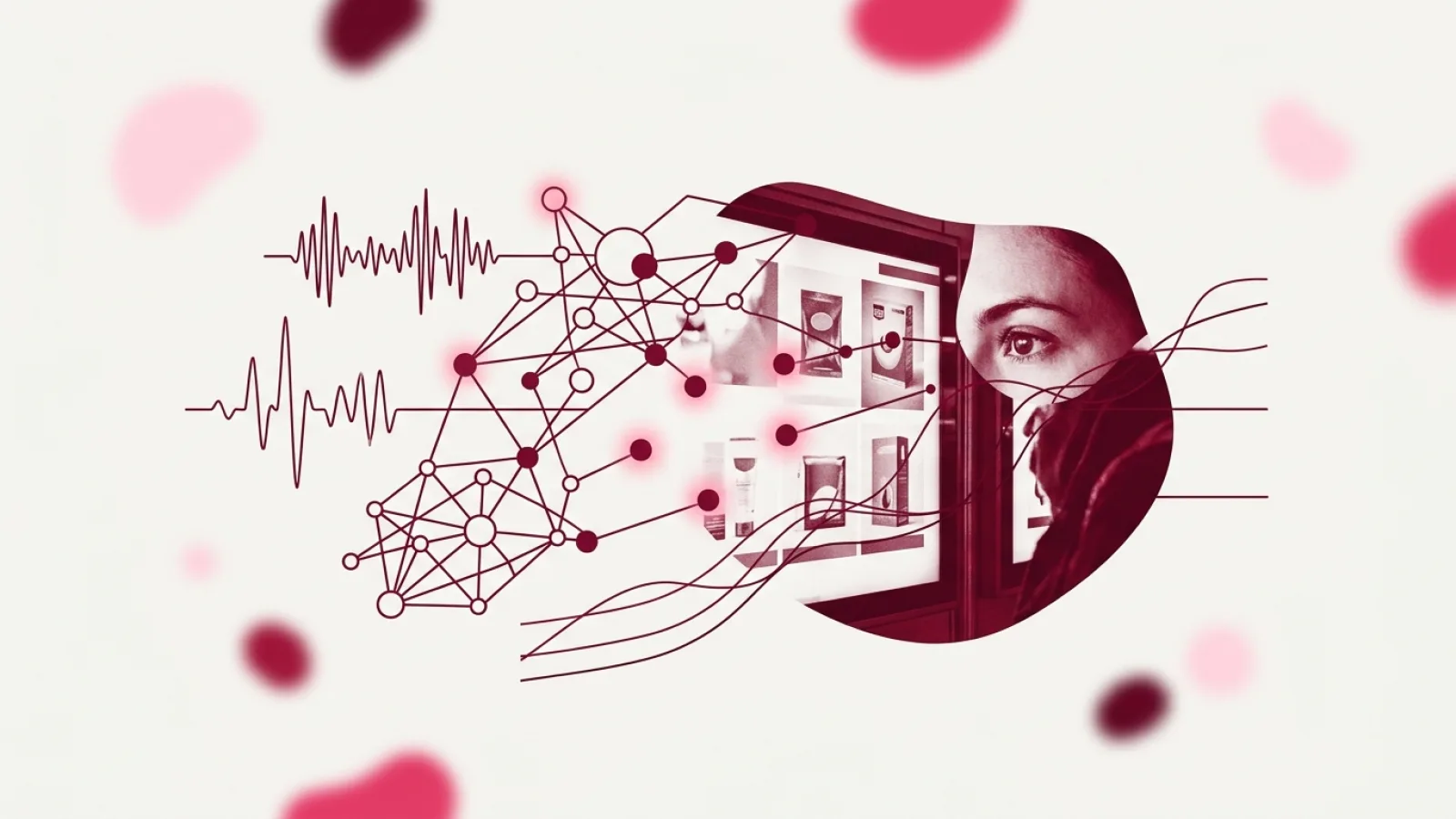
A predictive heatmap estimates where people will look during the first seconds of exposure to an ad, before it runs and without recruiting a single participant. It comes from models trained on eye-tracking recordings from thousands of real people, which learned which elements draw attention in an image or a video. AI pretesting uses that estimate, together with a few other measures, to decide which creative goes to media and which fixes are worth making first.
Which signals does a predictive heatmap measure?
Early visual attention: the probability that an area receives eye fixations during a short exposure of a few seconds. Red zones carry the highest probability; cold zones sit outside the typical viewing path.
Three companion outputs make the map useful:
- Attention share per area. How much attention each element gets: logo, product, headline, call to action. It turns the map into a number you can compare across versions.
- Clarity and cognitive load. Whether the layout is easy to process or demands effort. A crowded ad spreads attention across too many points and loses its message.
- Emotion and memory. An estimate of emotional response and of how likely the content is to be remembered. On the Databrain platform these outputs combine into an impact score that sums up a creative in one figure. The prediction technology is Powered by Neurons.
These outputs describe the first reaction, the automatic one that comes before any opinion. That reaction decides whether an ad gets looked at or ignored, which makes it the first filter in any pretest.
Where do the estimates come from?
From people. The models are trained on eye-tracking studies and brain-activity recordings collected under controlled conditions, then validated against fresh human data. The Databrain tech paper covers the method, the quality controls and the model validation.
The difference from expert opinion is the empirical base: the model learned from measured behavior across thousands of cases and applies the same criterion to every new ad. Two people on a team can argue about whether the logo «stands out»; the model returns a percentage and returns the same one the tenth time around.
The link between attention, emotion and behavior is documented well beyond advertising. Blicher, Gleasure, Constantiou and Clement (2026) studied users' cognitive and physiological responses to image content in charitable crowdfunding campaigns and examined how attention and emotion relate to donations. European Journal of Information Systems, 2026.
How does it fit into a real pretest?
The workflow that holds up best in marketing teams and agencies has four steps.
1. Decide which elements have to be seen
Before any analysis, the team agrees on the three elements the ad must communicate at first glance: usually brand, product and promise or call to action. Those become the areas of interest to measure.
2. Run every version through the same criterion
Upload the variants (formats, backgrounds, logo placements, different video lengths) and get maps and percentages for each. Comparison is immediate because the model applies one rule to all of them.
3. Fix the visual hierarchy
The same problems come up again and again: a face or a decorative element stealing attention from the product, a logo outside the viewing path, a headline competing with the image, a call to action in a cold zone. Each fix goes back through analysis until the hierarchy matches the intent.
4. Validate with people when the decision warrants it
For high-budget campaigns or packaging decisions, AI pretesting pairs with a study on real participants, for example screen-based eye tracking or a remote study. AI narrows the field to two or three candidates; the human study confirms the pick.
Which decisions does it improve, and which does it leave alone?
It improves decisions about layout and hierarchy: where the logo goes, how large the product is, whether the copy is legible, which second of the video shows the brand. It also improves process efficiency: ten variants take minutes to analyze and cost a fraction of a traditional study. That changes the question a team can afford to ask. Instead of testing one finished campaign, it tests every option on the table and keeps the strongest one.
Decisions about the message, the humor or brand fit remain human. The model tells you whether the headline gets looked at; the team decides whether the headline is any good.
How do you add pretesting without slowing the creative process?
Three habits keep pretesting from turning into paperwork:
- Analyze drafts, not just finals. A render or a single frame is enough to catch a hierarchy problem. Fixing it at that stage takes an hour; fixing it after production takes a week.
- Set benchmarks per format. Each team decides what share of attention on the brand counts as enough for a banner, a reel or a billboard, and revisits that figure against campaign results.
- Keep the history. Over time, the archive of analyses shows which devices work for that brand and that audience, and the team designs better from the first draft.
Does a predictive heatmap replace eye tracking with people?
It complements it. AI handles exploration and comparison across versions; a study with people confirms the final decision when the stakes justify it.
Does it work for video?
Yes. Video is analyzed frame by frame, showing which second the brand appears in, how long it holds attention and where attention drops off.
How long does an analysis take?
Seconds for an image, a few minutes for a video. The real time cost is the team's review, not the processing.
Run your next creatives through Databrain's artificial intelligence: three images and one video on the house, no card required. Prefer a walkthrough with a specialist? Book a meeting.
